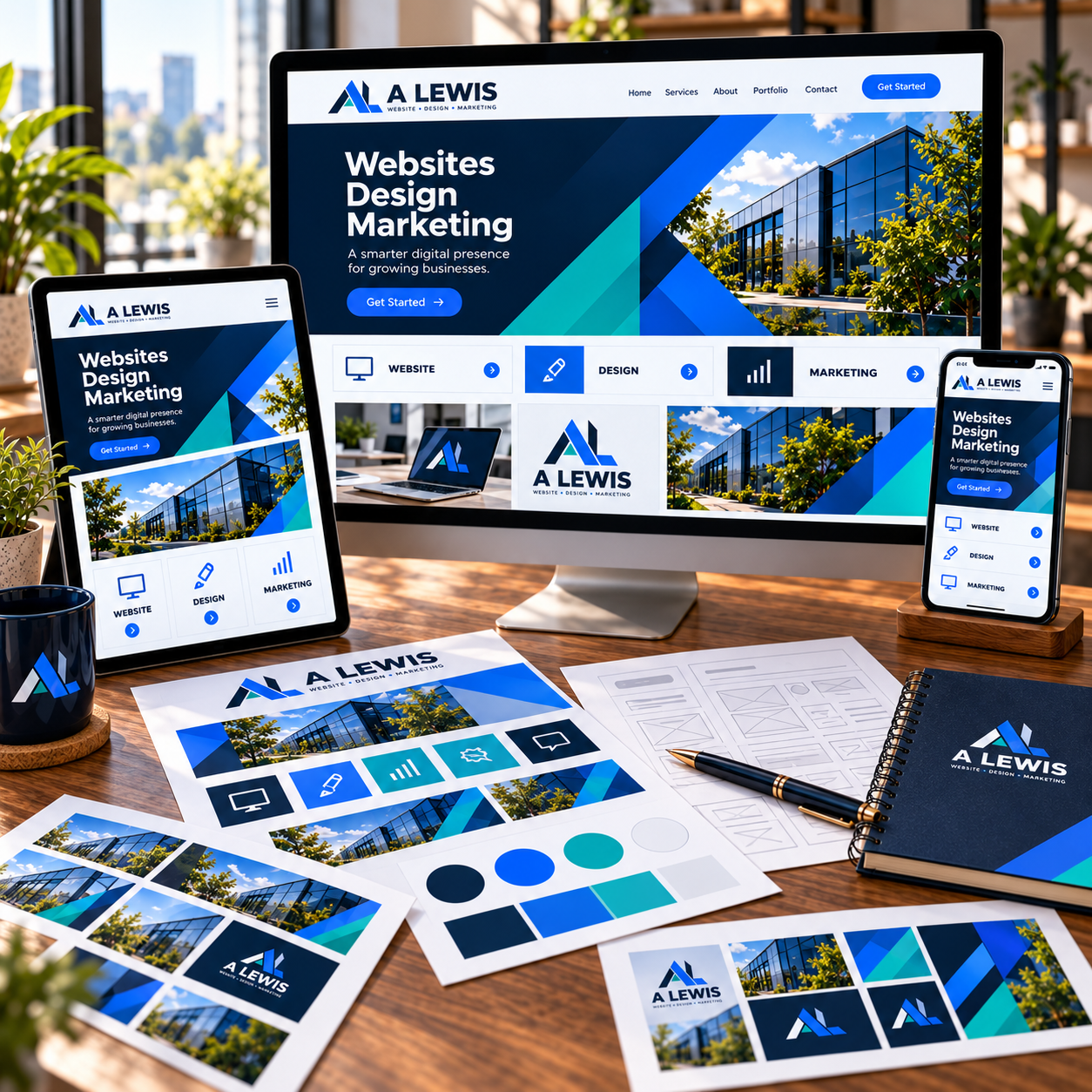
Professional Websites Built for Local Business Growth.
A clear, consistent visual identity helps customers recognise your business and understand the quality of your services. A Lewis creates practical graphic design for websites, social media, print and marketing.
Based in Crowborough, East Sussex, I support businesses across Tunbridge Wells, East Grinstead, Tonbridge, Uckfield, Heathfield, Forest Row, Wadhurst, Mayfield, Haywards Heath, Kent and surrounding areas. Whether you need a new logo, business stationery, social graphics, website visuals or marketing materials, the design is planned around your audience, message and intended use.
Graphic design is not only about making something look attractive. It is about helping people recognise your business, understand your message and feel confident taking the next step. Colour, typography, spacing, imagery, layout and hierarchy all influence how information is received.
A business may have a strong service but still appear inconsistent if the logo is used in different ways, social graphics have unrelated styles, printed material feels disconnected from the website or important information is difficult to read. A Lewis brings these elements together into a visual direction that is practical to use across the places your customers see your business.
Design decisions should also reflect the context. A logo for a professional service may need to work at a small size on a website header, while a social graphic may need to communicate one idea quickly on a phone screen. A business card needs readable contact details, and a website hero needs enough contrast for text and buttons. Each item is designed for its real purpose rather than treated as an isolated picture.
Use colour, type and visual details consistently so customers can identify your business.
Organise text and imagery so the main message is understood without unnecessary effort.
Create files and layouts that can be adapted for website, social, print and digital use.
Give every customer touchpoint a considered, credible and consistent appearance.
The right design depends on where your business is now and what you need to communicate next. Some businesses need a complete visual identity, while others need a set of supporting assets that work with an existing brand. The services below can be delivered individually or developed as part of a wider website and marketing project.
Good design begins with understanding what the asset needs to achieve and where it will be used.
Clients remain responsible for approving factual information, contact details, prices, claims, supplied images and third-party materials. You must have permission to use any content supplied for a project. Additional revisions or a complete change of direction may be quoted separately when they fall outside the agreed scope.
Discuss your business, audience, message, existing brand, competitors and the intended use of the design.
Agree visual direction, dimensions, content, references, file requirements and the number of review stages.
Develop the artwork carefully for its real application, with attention to readability and brand consistency.
Check the final design, apply agreed corrections and supply appropriate files for digital or print production.
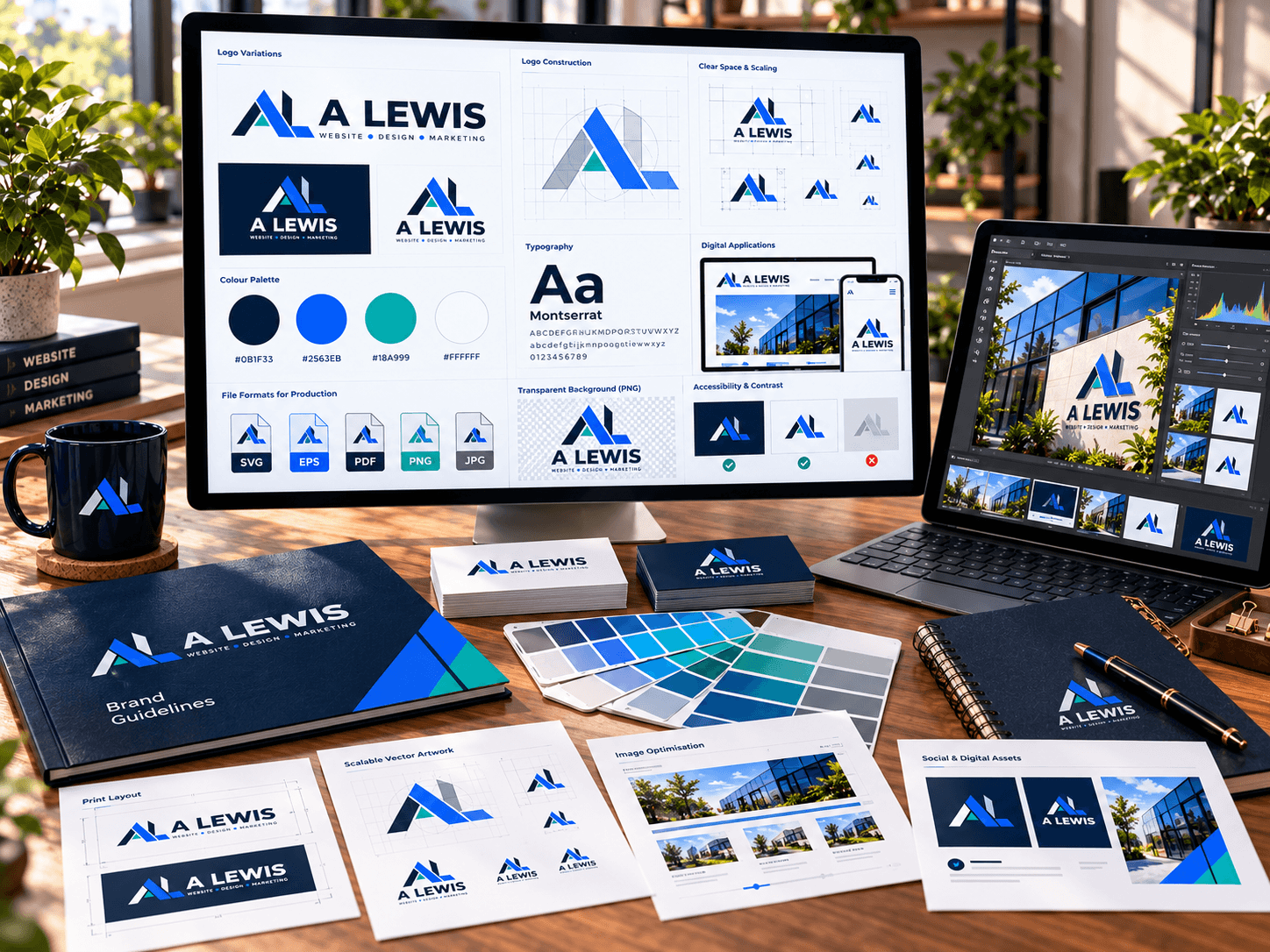
Your logo is one part of your identity, but it needs to work alongside colour, typography, imagery and layout. A Lewis can help create or refine a visual identity that reflects your business and remains practical across different applications.
Logo work may include initial direction, visual concepts, type and colour choices, variations for light and dark backgrounds, horizontal and stacked arrangements, and files suitable for website, social and print use. The design should remain recognisable when it is displayed large on a presentation or small in a website header.
A useful brand identity also provides guidance for everyday use. This might include primary and supporting colours, heading and body fonts, spacing, image direction and examples of how the logo should be positioned. Clear guidance helps prevent the brand from changing appearance every time a new post or document is created.
The aim is not to make a business look like every other business. It is to create a confident, appropriate visual foundation that supports the way your customers understand your services.
Printed material still matters for many businesses. A business card, leaflet, brochure, flyer or appointment card can create a useful physical reminder after a conversation. It needs to present the essential information clearly and use the correct dimensions, bleed, safe area, colour mode and file format for the intended printer.
A Lewis can design business cards and print materials that align with your website and wider identity. This can include contact information, service summaries, QR codes, social links, calls to action and carefully chosen imagery. The layout should allow people to find the important details quickly rather than filling every area with text.
Print design should also consider how the finished item will be handled. Small type, low contrast, crowded margins or overly detailed artwork may not reproduce well. A review of the printer’s specifications before production can reduce avoidable problems and help the final piece look as intended.
Social media graphics need to communicate quickly, often on a small screen. They should have a clear focal point, readable text and enough brand consistency to be recognised as yours. A Lewis creates platform-aware graphics for channels such as LinkedIn, Facebook, Instagram and X.
Social assets may include announcement graphics, service highlights, project images, educational posts, quote cards, event promotions, banners and simple visual explainers. The design can be adapted to square, portrait, landscape or header formats while retaining the same visual direction.
Good graphics do not replace good content. The image and accompanying caption should work together, with an appropriate link or call to action where useful. If the post leads to your website, the destination should answer the promise made by the graphic and be comfortable to use on a phone.
Customer photographs, logos and reviews should only be used with the appropriate permission. Claims should be accurate and the final post should be checked before publication.
Website graphics help guide attention and support the structure of a page. They can include hero imagery, service icons, section illustrations, banners, device mockups, background shapes, diagrams and call-to-action visuals. The design should work with the content rather than distract from it.
A Lewis creates digital assets with responsive use in mind. A graphic that looks effective on a desktop monitor may need to crop differently on a phone. Text should not be baked into an image when it needs to remain accessible and searchable. Important information is usually better presented as live HTML text over a suitable visual background.
Images should be prepared at an appropriate size, compressed responsibly and given accurate alternative text where they communicate meaning. Decorative images should not create unnecessary noise for screen-reader users. The finished assets should support the website’s loading performance and accessibility rather than create a visual barrier.
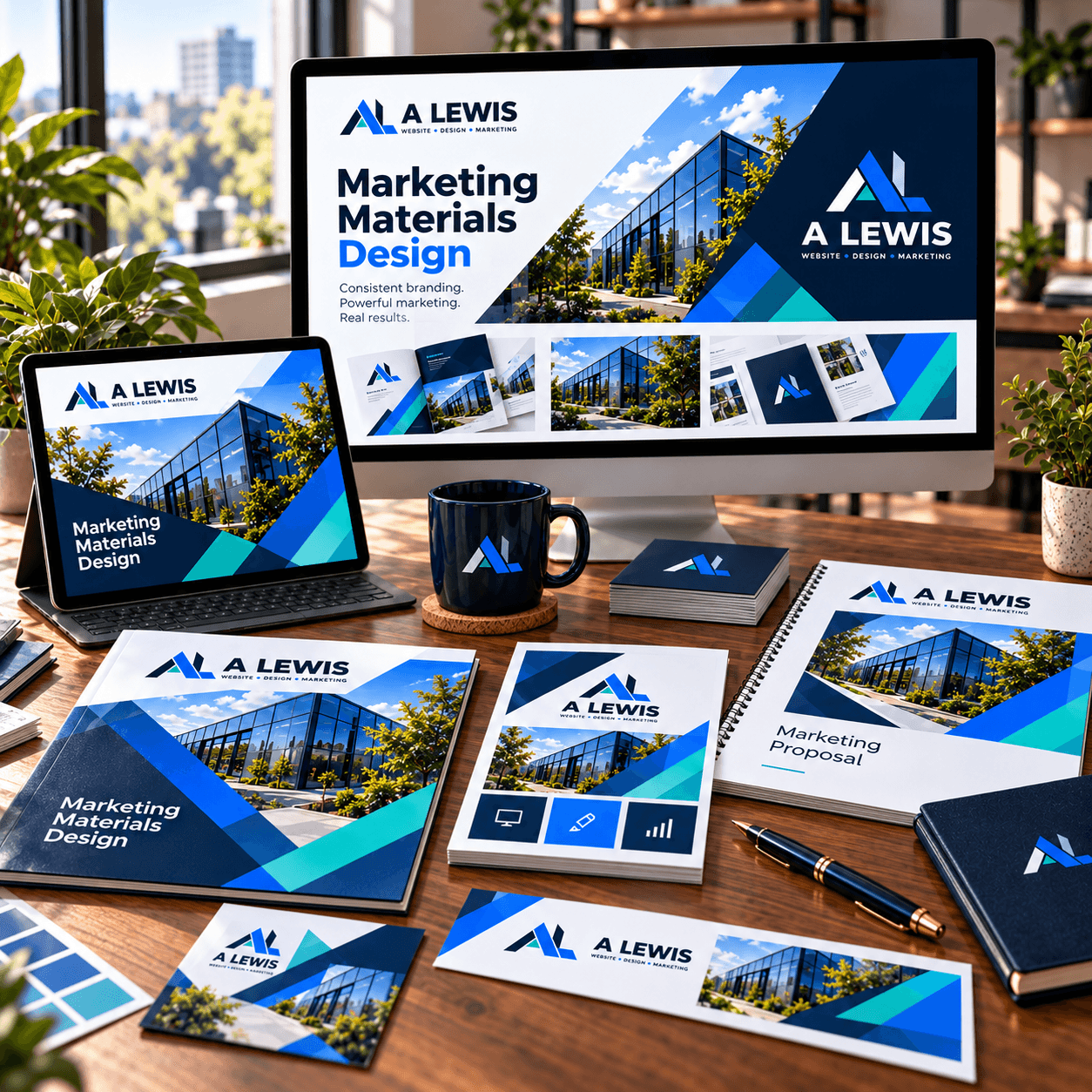
Marketing materials may include presentations, proposal covers, campaign graphics, digital brochures, email headers, social templates, signage, event materials and downloadable guides. Each piece should help communicate a specific message to a defined audience.
Design can be developed from an existing brand or created as part of a new visual direction. It may combine photography, diagrams, illustrations, icons, headings, supporting copy and a clear call to action. For B2B customers, the layout should support easy scanning and make the most important evidence visible.
Digital and print versions may require different dimensions, colour settings and file formats. A Lewis can prepare assets according to their intended use and identify where a design needs to be adapted rather than simply stretched or resized.
Graphic design is most useful when it supports the wider customer journey. A new logo should appear correctly on the website. Social graphics should lead to pages that match their message. A campaign should use the same visual language across landing pages, posts and supporting material.
Responsive WordPress websites, redesigns, landing pages, small-business websites and ongoing care.
Content, campaigns, social media support and reporting that help your activity work together.
Local SEO, Google Business Profile, on-page optimisation, audits, reporting and structured data.
Professional design depends on judgement as much as software. Adobe Illustrator is useful for logos, vector artwork, icons and scalable graphics. Adobe Photoshop can support image editing, compositing, retouching and raster-based artwork. The choice of tool depends on how the finished asset will be used.
Files should be supplied in suitable formats. A logo may need a vector master such as SVG, EPS or PDF together with transparent PNG versions. A social graphic may need an optimised JPG or PNG. Print artwork may need a press-ready PDF with the printer’s specified bleed and colour settings. Keeping organised master files helps future edits and reduces the need to rebuild artwork from a compressed image.
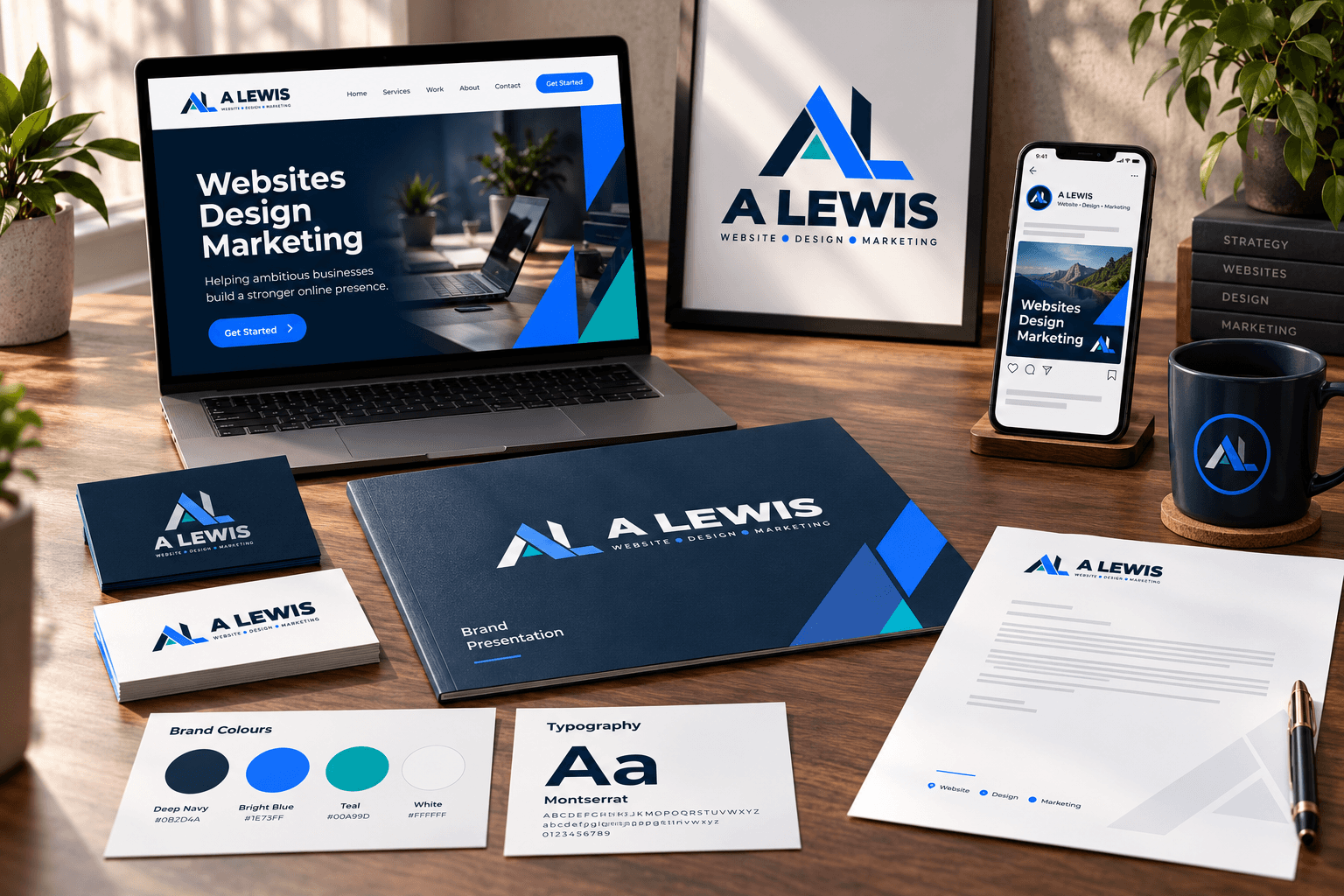
Design also involves careful use of typography. The A Lewis brand uses Montserrat for headings and Inter for body copy, supported by a navy, blue, teal and white colour system. These choices create a consistent look across the website, business documents and social assets while still allowing individual designs to have their own purpose.
Accessibility should be considered from the start. Text needs sufficient contrast, font sizes should remain readable and meaning should not depend on colour alone. A visual design can be distinctive without making information difficult to access.
B2B design needs to balance professionalism with clarity. Customers often want to understand a service, compare options and decide whether a provider is suitable. A well-designed proposal, presentation, case study or website section can make that information easier to follow.
Visual hierarchy helps guide the reader. Strong headings, meaningful diagrams, appropriate spacing and supporting images can make complex information more approachable. The design should not hide important details behind decoration. It should help customers see the evidence, process and next step.
A Lewis can develop a consistent visual approach for business documents, website sections and LinkedIn content so that the communication feels connected. This can be especially useful when several people create or share material on behalf of the business.
Design can improve recognition, clarity and confidence, but it cannot guarantee a specific number of enquiries, sales or revenue. Results also depend on the offer, customer experience, marketing activity, reputation, competition and how consistently the assets are used.
AI-assisted tools may be used for ideas, image exploration, drafting or workflow support where appropriate. Final artwork and content should be reviewed by a person for accuracy, originality, brand suitability, licensing, accessibility and ethical use. AI should not be used to create misleading claims, fabricated testimonials or unlicensed material.
Images, fonts, icons, stock assets and third-party elements may have licence conditions. The project quotation should make clear which assets are included and which costs are the client’s responsibility. A Lewis will not assume that client-supplied material is free to use; the client must confirm permissions.
Clear expectations protect both sides. A good brief should identify the purpose, audience, dimensions, content, references, deliverables, review stages and deadline before production begins.

Customers can identify your business more easily across different channels and formats.
Visual hierarchy makes your services, message and supporting evidence easier to follow.
Consistent, carefully prepared assets help your business appear organised and professional.
Reusable files and guidance make it easier to maintain the same standard as your business grows.
A Lewis is based in Crowborough and supports suitable design projects across East Sussex and Kent. This includes businesses in Tunbridge Wells, East Grinstead, Tonbridge, Uckfield, Heathfield, Forest Row, Wadhurst, Mayfield and Haywards Heath, together with nearby areas.
Local knowledge can help a design feel relevant, but the visual identity still needs to represent the whole business. A local reference may be appropriate in a campaign, project image or service message, while the core logo and brand system should remain flexible enough for wider work.
Projects can be managed through email and online review, with in-person conversations where practical. The important part is a clear brief, suitable reference material and agreed feedback so that the final work supports your real business needs.
A Lewis provides logo and brand identity support, business cards and print design, social media graphics, website graphics and digital assets, and marketing materials design.
Yes. Existing colours, fonts, logo files and website layouts can be reviewed so new graphics support the visual style rather than appearing disconnected.
Yes. Support is available for suitable businesses in Crowborough, Tunbridge Wells, East Grinstead, Tonbridge, Uckfield, Heathfield, Forest Row, Wadhurst, Mayfield, Haywards Heath, East Sussex, Kent and nearby areas.
The files depend on the project and intended use. Digital assets may be supplied as PNG or JPG, while logos and print work may require SVG, PDF, EPS or other formats. The agreed quotation should confirm the deliverables and any third-party licence arrangements.
We use cookies to improve your experience on this website. You may choose which types of cookies to allow and change your preferences at any time. Disabling cookies may impact your experience on this website. You can learn more by viewing our Cookie Policy.